Canada is “absolutely not” competitive on tax policy, said Bank of Montreal Chief Executive Officer Darryl White, who called on the federal government to cut taxes even if it means running a larger deficit.
Darryl White, chief executive officer of BMO Financial Group, speaks during the US-Canada Summit in Toronto, Ontario, Canada, on Tuesday, April 4, 2023. The event will focus on politics, trade, tech innovation, security, energy, and the environment.
By Christine Dobby
(Bloomberg) — Canada is “absolutely not” competitive on tax policy, said Bank of Montreal Chief Executive Officer Darryl White, who called on the federal government to cut taxes even if it means running a larger deficit.
With trade issues dominating the national debate, tax incentives for investment aren’t getting enough attention, White said Wednesday at the Toronto Global Forum.
Prime Minister Mark Carney’s government cancelled an unpopular increase to the capital-gains inclusion rate, but it needs to go further, White said, such as by letting businesses write off capital assets sooner and lowering corporate and personal taxes.
“We have a little bit of fiscal capacity to play with here,” he said. While he’s normally a supporter of balanced budgets, “this is a moment where — throw that out the window and take a little bit more risk.”
He said Canada should seize the momentum created by U.S. President Donald Trump’s trade policies, which have prompted a rethink of internal barriers to trade and Canadian exporters’ dependence on the U.S. market.
“Are we letting a crisis go to waste? Are we competitive on tax? I know the answer to that is, ‘Absolutely not,’” he said.
In July, the federal government cut the country’s lowest income tax rate by one percentage point.
White, who’s led the country’s third-largest bank by market capitalization for almost eight years, said capital will “flow to the point of least resistance” — and Canada must make itself a destination. Other top executives, including other bank CEOs, have also pressed Ottawa for tax reform.
Carney’s government is set to unveil its first budget on Nov. 4, with the federal deficit expected to climb to at least $70 billion. National Bank of Canada Chief Economist Stefane Marion predicts a shortfall of about $100 billion, saying Ottawa will likely deliver a “stimulative budget.”
“We do have some fiscal room when you compare Canada to the rest to the world,” Marion said at a Bloomberg event last week. “We should not waste it.”
Vancouver-area home sales inched up in September from last year, but prices are still under pressure as sales stand well below long-term trends while listings rise, said Greater Vancouver Realtors.
Vancouver-area home sales inched up in September from last year, but prices are still under pressure as sales stand well below long-term trends while listings rise, said Greater Vancouver Realtors.
Sales totalled 1,875 in the month, a 1.2% increase from last year but 20.1% below the 10-year seasonal average, the board said Thursday.
There were 6,527 new home listings in September, a 6.2% increase from last year, leaving total listings up 14.4% from a year earlier at 17,079 homes. The total number of homes for sale was 36.1% above the 10-year seasonal average.
The rise in listings and tepid sales helped lead to a 3.2% decline in the composite benchmark price of a home from last year, and 0.7% lower from August, to $1,142,100.
While the market is under pressure, the association said last month’s interest rate cut from the Bank of Canada, with another expected before the end of the year, could help give some lift to the fall market.
“Easing prices, near-record high inventory levels, and increasingly favourable borrowing costs are offering those looking to purchase a home this fall with plenty of opportunity,” said Andrew Lis, the association’s director of economics and data, in a statement.
Detached home sales were up seven per cent in the month from last year as the benchmark price declined 4.4 per cent to $1,933,100. Apartment home sales rose 1.5% as the category’s benchmark price also dropped 4.4%, to $728,800. Attached home sales were down 5.8%.
While the market has been under pressure in recent years from interest rates, policy shifts and trade tensions, there is the potential for improvement in the months ahead, said Lis.
“With the acute impacts of these events now fading, we expect market activity to continue stabilizing to end the year, barring any unforeseeable major disruptions.”
People hunting for homes and mortgages have had a lot of economic and market news coming their way lately. Probably the most significant is the Bank of Canada’s decision to lower its policy rate.
As expected, the central bank trimmed a quarter of a point off its trendsetting interest rate, bring it to 2.50%. It is the first rate move since March.
The cut came a day after Statistics Canada reported the inflation rate rose to 1.9% in August, up from 1.7% in July.
Normally rising inflation would be a reason for the Bank not to lower its rate, due to concerns about over stimulating the economy and encouraging even more inflation. However, the Bank noted that other factors – such as stable (although higher than desired) core inflation, a decline in the gross domestic product and an increase in unemployment – indicate inflation is not a high risk.
The interest rate cut could make variable-rate mortgages look more attractive for those who are comfortable with potential rate movement.
The Canadian Real Estate Association reports August home sales increased 1.1% compared to July and were almost 2.0% better than a year earlier. The MLS Home Price Index showed flat pricing month-over-month, but registered a 3.4% decline year-over-year. CREA’s national average price was $664,000 in August 2025, up 1.8% from August 2024.
August new listings were up 2.6% over July and up 8.8% over a year earlier.
This article was published by the First National LLP Marketing Team on their website.
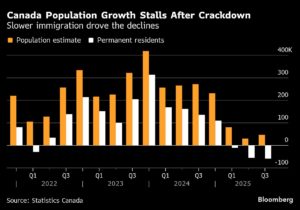
Once a runaway train, Canada’s immigration-driven population growth has come to a grinding halt.
By Randy Thanthong-Knight
(Bloomberg) — Once a runaway train, Canada’s immigration-driven population growth has come to a grinding halt.
For the second straight quarter, the country’s population changed nominally, compared with a quarterly growth rate of nearly 1% last year, according to Statistics Canada data released Wednesday.
Tighter immigration rules aimed at reducing the number of temporary immigrants drove almost more people out than new arrivals and natural births, with an increase of 47,098 people or 0.1% in the second quarter, the data showed. That’s a similar gain to the first three months of this year — and, except for 2020, the lowest growth rate in a second quarter since comparable records began in 1946.
The government’s plan to reduce the temporary migrant population appears to being working. The number of non-permanent residents dropped for the third time in a row, reaching 7.3% of the total population in the quarter, versus 7.6% at its peak. The decrease was driven by foreign students and workers leaving the country.
With half a year of essentially no population growth, Prime Minister Mark Carney’s government must decide whether to keep its tight lid on inflows or bring in more workers. The country’s new immigration targets are due Nov. 1.
It will be the first target set under Carney, who promised to bring immigration rates to “sustainable levels.” At the same time, his government wants to build homes and infrastructure to boost activity in a tariff-hit economy. That plan will require more skilled workers in trades and construction — sectors that still face labour shortages.
U.S. policies on immigration may also influence movements across the northern border, with some refugees as well as H-1B visa holders potentially heading to Canada.
In order to increase the number of intakes, Carney — who inherited eroded public support for mass immigration — will have to restore public confidence in the system and rebuild consensus around welcoming newcomers.
Like many of its advanced economy peers, Canada needs immigration to grow its population and tax base in order to replace workers and support its aging population. International migration accounted for more than 70% of population growth in Canada between April and June. In the second quarter, the number of births exceeded deaths by 13,404, with immigration adding 33,694 people.
Tepid population growth already clouded the economic outlook. Bank of Canada Governor Tiff Macklem said last week, when he resumed cutting interest rates, that low population growth as well as a weak labour market will weigh on household spending — a rare bright spot in the economy that contracted sharply last quarter.
Oxford Economics says Canada’s economy will stay weak through 2025, with housing activity picking up but prices still expected to slide into 2026.
Oxford Economics expects Canada to remain on the edge of recession through 2026, warning that broad-based weakness across the economy shows little sign of easing.
The outlook was shared during the firm’s September Office Hours call, where economists pointed to persistent sluggishness across key sectors despite cooling inflation and recent rate cuts from the Bank of Canada.
Ongoing uncertainty around trade, a softening labour market and a housing market still searching for the bottom were flagged as key risks, with the path ahead also vulnerable to policy shocks such as the federal budget this fall.
Weak growth and a softening job market
Oxford Economics said the economy will “remain on the verge through the second half of 2025, teetering on recession,” with the Bank of Canada’s recent cut described as consistent with easing inflationary risks and faltering growth. Another reduction in October was noted as possible, though the outlook “is still subject to policy shocks,” including a fiscal boost anticipated in the federal budget this fall.
The firm now expects inflation to average 2.6% next year, down from earlier projections of 3%, while the labour market will continue to feel the strain. “We think there’s still a little bit of a hit coming to lift unemployment to 7.4%,” the call noted, though the rate should fall relatively quickly into 2026 as population growth slows.
The outlook pointed to a prolonged weak growth cycle. “Our outlook for the Canadian economy is not that optimistic — we expect to remain on the edge of recession into 2026, with overall growth close to zero,” Oxford said. Quarter-by-quarter gains are expected to come slowly, in the range of just one to three tenths of a percent.
Uncertainty over tariffs under USMCA was also cited as a risk. Until Canada secures a deal similar to those achieved by the UK or EU, the firm noted a cloud of uncertainty is expected to hang over tariff rates, dampening investment and related sectors.
Tentative housing rebound overshadowed by falling prices
Oxford Economics pointed to early signs of improvement in resale activity, noting “a pickup in sales and average prices in Toronto and Vancouver, and listings have also risen, so overall activity is starting to move a little bit.” However, benchmark prices — described as the stronger gauge — “have continued to drift lower.”
Further rate relief is expected to bring more buyers and sellers back into the market this fall, though the balance is likely to tilt toward a buyer’s market. “There will be a pickup in activity, but it will lead to prices drifting lower into 2026,” Oxford said.
Modest price growth could resume by 2027, but structural headwinds are expected to limit the upside. “Demographic shifts will limit overall housing demand, alongside ongoing affordability challenges, especially in the Greater Toronto and Greater Vancouver areas,” Oxford noted.
Over the longer term, home prices are expected to rise only slightly faster than inflation. “We anticipate a housing market rebalance in the late 2030s, but over the next five to 10 years house prices will be largely flat in real terms,” the firm said.
Government ambitions tempered by structural limits
On the construction side, Oxford Economics is projecting limited momentum in the near term. “The next couple of months and quarters are not looking particularly good,” the firm noted, with a relative uptick expected only by late 2026. Even then, the baseline is described as low, and any rebound would resemble a return to balance rather than a boom.
Government ambitions add another layer of complexity, with Ottawa’s recently announced Build Canada Homes program calling for a near doubling of housing output through modular and mass-timber construction. But Oxford warned such targets risk overshooting. “We think the government’s plan to double housing supply overdoes it. We see housing starts peaking near the 300,000-unit range in the latter half of the decade. With changing factors including aging boomers selling homes, for example, we could face an oversupply situation by the end of the decade if that government plan comes true.”
For now, the Canadian economy appears set to remain in a holding pattern — not fully in contraction, but still far from a clear path to recovery. With tariffs in flux, inflation expected to tick slightly higher in the long term, and housing still adjusting, the market is shaped more by uncertainty than conviction.
Steven is a finance writer with over four years of experience, working across several finance verticals. His writing has appeared on LowestRates.ca, Loans Canada, InTheKnow, Yahoo Finance and more. He holds an MA in World Literature from Maynooth University in Ireland, and currently resides in Vancouver, B.C.
Not all “first-time buyers” are created equal. Here’s how the rules differ across Canada’s most-used programs.
If you’ve been poking around the idea of buying your first home in Canada, you’ve probably noticed that “first-time homebuyer” doesn’t always mean what you think it does. Different programs, federal and provincial, define it in different ways, and that can make things confusing fast.
We work with a lot of clients who get tripped up by this. Someone will tell me they’re a first-time homebuyer because they’ve never bought a home in Canada, only to discover their previous home in another country disqualifies them from a key benefit here. Or, on the flip side, someone who owned a condo years ago doesn’t realize they might still qualify for certain first-time buyer programs again under the right circumstances.
So let’s break it down. Here’s how “first-time homebuyer” is defined across three major programs Canadians often rely on: the Ontario Land Transfer Tax Rebate, the RRSP Home Buyers’ Plan (HBP), and the First Home Savings Account (FHSA).
How does Ontario define a first-time homebuyer for the land transfer tax rebate?
If you’re buying property in Ontario, the land transfer tax (LTT) rebate is probably the first program you’ll hear about. It can save you up to $4,000 on the provincial land transfer tax, and another $4,475 on the Toronto municipal land transfer tax if you’re buying in the city.
But the eligibility rules here are strict.
The never-ever rule
To qualify:
You must be at least 18 years old
You must have never owned a home or any interest in a home anywhere in the world
You must live in the home as your principal residence within nine months of the purchase
And, here’s the kicker, your spouse or common-law partner must also never have owned a home while you’ve been together
That last point trips up a lot of couples. If your partner owned a home before you got together, you’re in the clear. But if either of you owned a property while in a relationship with the other, even if it was overseas, you’re disqualified.
I’ve had to deliver that disappointing news more than once. It’s a harsh line, but that’s the rule.
“The latest addition is that a purchaser must be either a Canadian Citizen or have Permanent Resident status.We had a file recently where spouses bought a house together- they are both first time homebuyers but she doesn’t have her PR yet so they got only half the rebate. Once she gets her papers she can apply for the rebate within 30 days of getting a confirmation of residency, very short window of opportunity.”
Maria went on to say she often hears comments like, “How would they know if I owned something back in X? The answer is all government agencies are inter-connected. Therefore, when they are applying for immigration and put in their application that they owned a home back home, it may trigger a re-assessment, together with penalties.”
How does the RRSP Home Buyers’ Plan define a first-time homebuyer?
The HBP is a popular option for buyers who want to tap into their RRSP savings, up to $60,000 per couple, to help with a down payment.
Thankfully, this program is more forgiving than the LTT rebate.
The four-year look-back rule
To qualify:
You must not have lived in a home that you (or your spouse/common-law partner) owned in the current year or the four preceding calendar years
You need a signed agreement to buy or build a qualifying home
You must intend to make that home your principal residence within one year
You must be a resident of Canada at the time of the withdrawal and when you buy the home
So yes, you can technically qualify again even if you’ve owned property before. As long as you (and your current spouse or partner) haven’t lived in an owned home in that four-year window, you may still be eligible.
I call this the “fresh start” clause. It’s particularly useful for people who sold a home years ago and have been renting since.
How does the First Home Savings Account define a first-time homebuyer?
The FHSA is the new kid on the block, and honestly, it’s a game-changer. It combines the tax perks of an RRSP and a TFSA, and lets you contribute up to $40,000 toward your first home purchase.
But, like the HBP, it also uses a version of the four-year lookback rule.
Similar to HBP, but tied to ownership and occupancy
To open and use an FHSA:
You must be between 18 and 71 years old and a Canadian resident
You must not have owned or jointly owned, or lived in, a qualifying home in the calendar year before you open the FHSA or during the previous four calendar years
This rule also considers property owned by your spouse or common-law partner that you lived in
The FHSA’s definition of a first-time homebuyer is almost identical to the HBP’s, but there’s one nuance: the timing starts before the account is opened. That means you have to meet the definition at the time you open the FHSA, not just when you use it.
This is crucial. We tell our clients: if you’re even thinking about buying your first home in the next few years, open your FHSA sooner rather than later, even with a minimal contribution, to start that eligibility clock.
How do the definitions compare?
Let’s stack them side by side so you can see where things align, and where they don’t.
Program
Never Owned Anywhere
Four-Year Lookback
Spouse/Partner Ownership Included
Notable restriction
LTT Rebate (ON)
Yes
No
Yes
Ever owned (anywhere) = disqualified
HBP (RRSP)
No
Yes
Yes
4-year rule based on occupancy
FHSA
No
Yes
Yes
4-year rule based on ownership + occupancy
The key takeaway? The LTT rebate is the strictest. HBP and FHSA are more flexible, especially if you’ve taken a break from homeownership or recently separated from a partner who had a home.
Our advice
Don’t assume you are (or aren’t) a first-time buyer until we really look at the details. Each program plays by its own rules, and timing, relationship history, and past ownership all matter.
Here’s what we recommend:
Talk to a mortgage expert early: They can walk you through each of these definitions based on your personal history
Open your FHSA early if there’s any chance you’ll buy in the next few years. You’ll be glad you did
Be honest with yourself (and your partner) about your ownership history, even that vacation property from 15 years ago might count
Don’t leave money on the table. We’ve seen clients qualify for benefits they didn’t know they were entitled to, and others miss out because they made assumptions
Does first-time buyer status matter for mortgage purposes?
Actually, for an insured mortgage, it can matter if you are a first time homebuyer.
Repeat buyers are eligible for a 30-year amortization with mortgage insurance only when purchasing newly built homes.
First-time homebuyers are eligible regardless of whether they are buying a new or resale home.
Repeat buyers purchasing resale (existing) homes are not eligible for a 30-year amortization with mortgage insurance—the maximum remains 25 years in these cases.
Whether you’re buying your very first home or just your first in a while, knowing which programs you qualify for can save you thousands, and make your homeownership journey much smoother.
Ross Taylor is dedicated to empowering Canadians with financial literacy and expertise in housing, credit, and real estate. With over 20 years of experience as a mortgage broker, Ross has helped thousands of Canadians navigate the complexities of home financing and credit management. His passion for education drives him to demystify the mortgage process, ensuring clients make informed decisions. Discover more valuable insights and resources by visiting www.askross.ca/articles
Governor Tiff Macklem says the central bank will examine how its policies affect housing demand and affordability as part of its 2026 framework renewal.
The Bank of Canada will consider how its policies affect housing affordability as part of its next five-year monetary policy framework review.
In a speech delivered Tuesday in Mexico City, Governor Tiff Macklem said the Bank is preparing for its 2026 renewal by examining how monetary policy interacts with a housing market that has become increasingly unaffordable for many Canadians.
“Monetary policy cannot directly increase the supply of housing—that’s an issue for elected governments,” Macklem said. “But, through interest rates, monetary policy does have a direct effect on the demand for housing. And housing is a big part of the consumer price index in Canada, so the cost of housing affects inflation.”
“Therefore, it’s worth examining how monetary policy affects housing sector dynamics, and how best to factor housing affordability into our focus on overall price stability,” he added.
Macklem also hinted the Bank may revisit how it gauges underlying price pressures, suggesting the trim and median core measures could be reviewed. That comes as policymakers face more frequent supply shocks that can distort traditional readings of inflation.
Still, one element won’t change.
“As I said at the start of my remarks, there’s one key question we won’t be asking this time around,” Macklem said. “In our reviews since 1995, we’ve repeatedly asked whether 2% is the right target… Each time, we’ve concluded that targeting 2% inflation is the right framework for us.”
The Bank’s monetary policy framework is reviewed every five years in partnership with the federal government. The last review, completed in 2021, reaffirmed the 2% target and explored alternatives such as price-level targeting and nominal GDP targeting.
Steve Huebl is a graduate of Ryerson University’s School of Journalism and has been with Canadian Mortgage Trends and reporting on the mortgage industry since 2009. His past work experience includes The Toronto Star, The Calgary Herald, the Sarnia Observer and Canadian Economic Press. Born and raised in Toronto, he now calls Montreal home.
Canadians are increasingly counting on their homes to carry them through retirement, with many expecting to draw on property wealth through sales, downsizing or refinancing.
While homes have long been a source of wealth for Canadians, they’re now taking on an even bigger role in retirement planning.
New data shows 62% of adults view homeownership as central to their long-term security, with nearly half of unretired homeowners (44%) planning to sell their home to fund retirement, according to the 2025 Canadian Retirement Survey from the Healthcare of Ontario Pension Plan (HOOPP).
At the same time, concerns about mortgage debt are rising sharply as 65% of homeowners with a mortgage now worry they won’t be able to pay it off before retirement, up from 45% in 2023.
Homeowners more likely to save, but still worried
The survey also highlights the financial divide between homeowners and renters. Among unretired Canadians, 71% of homeowners said they have set aside money for retirement at some point, compared with just 36% of non-homeowners.
That disparity extends to total savings as well. Just 19% of homeowners reported having less than $5,000 set aside, compared with 57% of non-owners. By contrast, 18% of homeowners reported having over $200,000 in savings compared to just 3% of non-owners.
Despite this advantage, many homeowners remain uneasy about their retirement outlook, with 44% saying they are counting on the sale of their home to secure their financial future. That’s up from 42% in 2024 and 38% in 2023.
Another 33% say they are exploring remortgaging options in retirement to free up additional funds.
Other key findings
78% of mortgage holders said rising payments have forced or will force them to cut back in other areas just to keep up with housing costs.
An equal 78% said higher mortgage payments are reducing their ability to save for retirement.
Younger Canadians are especially likely to expect to rely on housing wealth, with 55% of those aged 18 to 34 planning to use the sale of their home to fund retirement (compared to 44% overall and 41% of those aged 55 to 64).
38% of homeowners said they would sell their home and downsize if they needed extra retirement income.
24% said they would consider going back to work full- or part-time
14% said they would use a reverse mortgage to stay in their home
46% of Canadians are concerned about mortgage, rent or other home payments in retirement.
48% of Canadians said they’re worried about what interest rates will do to their ability to afford current or future mortgage payments.
84% of renters said they are worried about the rising cost of rent.
Steve Huebl is a graduate of Ryerson University’s School of Journalism and has been with Canadian Mortgage Trends and reporting on the mortgage industry since 2009. His past work experience includes The Toronto Star, The Calgary Herald, the Sarnia Observer and Canadian Economic Press. Born and raised in Toronto, he now calls Montreal home.
From tax implications to AML compliance, here’s what borrowers need to know before turning digital wealth into a mortgage.
Crypto mortgages are becoming a hot topic in Canada, but there’s still a lot of confusion around how they work. For Canadians with significant holdings in Bitcoin, Ethereum, or other digital assets, the idea of using that wealth toward homeownership is appealing.
However, turning crypto into a viable down payment, or leveraging it as collateral, isn’t as simple as it sounds. Between tax implications, lender skepticism, and regulatory requirements, the path from digital wallet to mortgage approval requires careful planning and documentation.
Case studies: when crypto becomes a mortgage down payment
1) Recently, Brian Hogben of Mission 35 Mortgages worked with a client who had already converted cryptocurrency into Canadian dollars. The funds had been sitting in a bank account for over 90 days, typically enough to meet lender documentation standards.
The challenge was finding a lender, and more importantly, an underwriter, who understood crypto. Several major banks refused to proceed, despite the funds being seasoned and in fiat. Progress finally came through Bank of Montreal, which Brian explained has a specialized underwriting team familiar with crypto-related transactions.
After tracing the fund origins and confirming they were compliant with anti-money laundering (AML) standards, BMO approved the mortgage. It was a breakthrough, but it also highlighted how new and misunderstood crypto remains in the mortgage space.
2) A few years ago we ran into the exact same thing with clients purchasing a home in the Greater Toronto Area. They found us only one week before their closing date as their bank had withdrawn their mortgage approval. The reason was because the down payment was largely coming from digital wallets containing their crypto funds.
The only available solution was a private first mortgage, which we placed with Vault Mortgages. Everything went well, in spite of the tight timeline, and the buyers avoided losing their $250,000 deposit.
Interestingly, when they wanted to refinance within six months, they ran into the exact same problem. The banks still wanted to verify their down payment for the original purchase.
What is a crypto mortgage and how does it work?
Crypto mortgages typically fall into one of two categories:
Crypto-funded mortgage: You sell your crypto, convert it to Canadian dollars, and use those funds as your down payment. This is more common but comes with tax consequences.
Crypto-backed mortgage: You pledge your crypto as collateral without selling it. This may help you avoid triggering capital gains tax, but requires a lender capable of assessing and managing that risk.
How crypto-collateralized loans work
If you want to access liquidity without selling your crypto, a crypto-backed loan is another option. Here’s how it works:
1. Deposit crypto as collateral
You transfer your crypto to a platform, where it is held in a secure wallet or smart contract. Platforms such as YouHodler and Ledn support this model.
2. Loan-to-value (LTV) ratio
You can typically borrow between 30% and 70% of your crypto’s value. For example, pledging $10,000 worth of Bitcoin may get you a $5,000 loan.
3. Disbursement
Loans are issued in fiat (e.g., CAD, USD) or stablecoins. Most do not require a credit check and can be approved quickly.
4. Repayment and interest
Terms vary. Some platforms offer flexible repayment options; others require fixed schedules. Once the loan and interest are repaid, your crypto is returned.
5. Liquidation risk
If the value of your crypto drops and your LTV exceeds a certain threshold, you may be required to add collateral. Otherwise, your crypto may be liquidated.
6. No taxable event
Since you are borrowing, not selling, there is no capital gains tax event. This can be beneficial from a tax-planning perspective.
A simpler, safer alternative: using crypto ETFs for mortgage planning
For a more straightforward path, consider using crypto ETFs instead of direct crypto holdings. ETFs allow you to gain exposure to digital assets without managing wallets, keys, or exchange accounts.
Held through mainstream brokerages, including in TFSAs and RRSPs, crypto ETFs are easier for lenders to understand and verify, avoiding the friction that often comes with direct crypto assets.
Leading crypto ETFs in Canada
These are some of the top crypto ETFs available to Canadian investors:
BTCC (Purpose Bitcoin ETF): The first Canadian Bitcoin ETF, with CAD and USD options and a carbon-neutral version
BTCQ (3iQ CoinShares Bitcoin ETF): Physically-backed BTC, held in cold storage
FBTC (Fidelity Advantage Bitcoin ETF): Designed for registered accounts
ETHH and ETHX (Purpose and CI Galaxy Ethereum ETFs): Offer direct ETH exposure, with or without staking
IBIT (iShares Bitcoin ETF): Managed by BlackRock, a major global asset manager
Several ETFs now include additional exposure to AI stocks or newer crypto assets like Solana, expanding diversification options within this space.
Naturally, our readers should NOT assume this to be investment advice. Ask your licensed financial adviser for their opinion before proceeding please.
Can I use crypto as a down payment?
Yes, but there are strict conditions:
You must convert the crypto to Canadian dollars
Maintain a documented paper trail of the sale and deposit
Be prepared to explain the origin of your funds for AML compliance
Many lenders will still be hesitant. Working with a mortgage professional familiar with these requirements and a lender that understands crypto is essential.
Is it legal and safe in Canada?
Yes, but regulatory guidance is evolving. Lenders must comply with OSFI and FINTRAC standards, which include thorough AML and source-of-funds verification.
OSFI is expected to implement new digital asset rules in 2025, which may influence how Canadian financial institutions handle crypto-collateralized products.
Key risks to consider
Price volatility: A drop in crypto value can lead to margin calls or liquidation
Lender restrictions: Many banks still reject crypto-related funds
Platform risk: Some crypto lenders have gone bankrupt
No deposit insurance: Crypto held as collateral is not insured by CDIC
Compliance complexity: Documentation, tax reporting, and regulatory scrutiny can be significant
Who offers crypto-backed loans?
The following platforms offer crypto-backed lending services:
Ledn (Canada-based)
APX Lending (Canada-focused)
Binance
Coinbase
Crypto.com
YouHodler
SALT Lending
Aave and Compound (DeFi protocols)
For Canadians, I am told Ledn and APX Lending provide the most relevant regulatory alignment.
How does CRA treat crypto in mortgage scenarios?
Under CRA guidelines, cryptocurrency is treated as a commodity. Selling it to fund a down payment is a taxable event, and any capital gains must be reported.
However, borrowing against your crypto is not a disposition and does not trigger capital gains taxes, at least under current rules. Regardless, thorough documentation is critical.
Our advice
Crypto-backed mortgages and crypto-collateralized loans offer new possibilities, but they’re not ideal for everyone. If you’re a crypto holder considering homeownership in Canada:
Convert your crypto to Canadian dollars early, and let it season for at least 90 days
Alternatively, accumulate your crypto wealth in Exchange Traded Funds
Document everything: sales, transfers, deposits, and sources of funds
Work with professionals who understand both traditional lending and crypto
Be ready to meet rigorous compliance and verification requirements
Canada’s mortgage landscape is still catching up to the digital asset world. Planning ahead is key to avoiding delays or declined applications.
Ross Taylor is dedicated to empowering Canadians with financial literacy and expertise in housing, credit, and real estate. With over 20 years of experience as a mortgage broker, Ross has helped thousands of Canadians navigate the complexities of home financing and credit management. His passion for education drives him to demystify the mortgage process, ensuring clients make informed decisions. Discover more valuable insights and resources by visiting www.askross.ca/articles
The rent-versus-buy debate has long divided financial experts and aspiring homeowners, with no clear winner in sight.
The traditional argument holds: While buying a home can build long-term equity and stability, renting can provide flexibility and fewer upfront costs. But as home ownership becomes a far-fetched dream for many young Canadians, can renting for life be a viable option?
Alex Avery, author of The Wealthy Renter, thinks so.
“It’s different for every person, and each individual’s needs change over time, but I’m still a firm believer that renting is a great option,” he said.
Despite rental prices having soared since publishing his book in 2016, Avery says renting is still cheaper and carries less risk than buying.
“People compare mortgage payments to monthly rental rates, but mortgage payments don’t begin to cover the full costs of home ownership,” he said. These costs can include notary fees, realtor commissions and region-specific taxes when purchasing the property as well as ongoing costs such as mortgage interest, property taxes, insurance, and various maintenance and repair expenses.
Avery was inspired to write his book during what he calls was a “speculative bubble” in the housing market at the time that he said created a perception of home ownership as an “easy out for savings,” especially in urban centres like Toronto and Vancouver.
“[Young Canadians] were being pressured to buy a condo when the math never made any sense,” he said.
Vancouver realtor Owen Bigland’s calculations paint a different picture however. With average monthly rent for a one-bedroom unit in his city now hovering around $2,800, a lifetime renter could spend at least $1.3 million by the time they’re 65 (not accounting for rent increases or inflation), according to Bigland.
“And you’ll have zero to show for it. Where’s the savings here?” he questioned.
Even if monthly rent was cheaper than a mortgage payment, Bigland said many Canadians will likely spend any savings rather than invest it and grow their wealth.
“A lot of Canadians don’t have the discipline to save as much as they should,” said Sebastien Betermier, an associate professor at McGill University who studies Canadian household spending.
With rents making up at least a third of household expenditures, and homes making up 70% to 80 % of homeowners’ wealth portfolios, Betermier says both renters and homeowners alike are exposing themselves to big risks.
Recent data from a survey by the Healthcare of Ontario Pension Plan and Abacus Data suggests the same. More than a third of Canadians report having less than $5,000 in savings, and those who own a home are increasingly relying on their home equity to fund their retirement.
Bigland preaches home ownership for this very reason. He encourages chipping away at your mortgage and building equity so you can benefit from any price appreciation in the future.
“The only real cash shelter we get in Canada is the principal residence exemption,” he said.
Put another way, “you’re essentially renting [the home] from yourself,” said Betermier. He adds that your home can act as collateral should you need to borrow against it someday. Most mortgages from big banks typically include a built-in home equity line of credit at a favourable rate, according to Bigland. “It’s accessible money without selling your home.”
Avery, however, doesn’t buy this argument.
“It presupposes that housing is a safer investment than other investments,” he said. “There are many places where house prices have gone down, where employment prospects change over time.”
As an alternative to relying on your home as an investment, Avery suggests putting your money into an RRSP, TFSA, and the FHSA which doesn’t necessarily need to go toward a home purchase. “You can learn about index ETFs too. There’s a lot of different ways to invest your money,” he said.
Avery, who’s gone the home ownership route himself, doesn’t think buying is a bad decision, but warns against it if you’re banking on it as an investment tool.
“That’s conflating two different objectives,” he said. “One is to house yourself, and the other is to generate wealth.”
But Bigland, who’s also written a book on real estate and stock investing, says you should be doing both. He agrees renting can make sense in some situations like if you’re anticipating a change in jobs, but you should consider buying if you can commit to a location for eight to 10 years.
He suggests first-time buyers start with older buildings close to public transit often sitting on valuable pieces of land. “You’ll probably have a developer [buy] in 10 or 15 years, and that might be your exit strategy,” he said. “Even if you’re a blue-collar guy, if you can get $40,000 down, maybe even forgo the car for a little while, you can do it.”