24 Mar

Strong payment discipline masks growing mortgage stress, survey finds

General

Posted by: Dean Kimoto

Despite strong payment performance, a growing share of borrowers report difficulty keeping up and are cutting back on spending to stay current

Most Canadian homeowners are still meeting their mortgage obligations, but many are doing so under growing financial pressure, cutting back elsewhere to keep up.

True North Mortgage’s 2026 Mortgage Sentiment Survey, released today, found that 83% of Canadians have never missed a mortgage payment, even as borrowing costs rise. More than one-third (36%) of mortgage holders said they found it challenging to keep up with payments over the past year, pointing to mounting pressure on household budgets.

“Even as Canadians face rising household costs — from groceries to credit and potentially higher mortgage payments — homeowners overall remain financially prepared to meet their mortgage obligations,” said CEO Dan Eisner in a statement.

Mortgage payments remain stable, even as household budgets tighten

While arrears remain low overall, many households are making significant adjustments to their spending to stay current on mortgage payments. Among those surveyed, 57% reported cutting back in other areas to keep up, including 36% delaying or avoiding travel, 31% postponing home repairs, and 27% reducing retirement savings or investments.

The data from True North Mortgage suggests that mortgage payments continue to be prioritized, even as mortgage holders are squeezed across spending categories. That pattern is consistent with what brokers are seeing on the ground, according to Chad Wilson, principal broker at Ideal Mortgage Solutions.

“We’re finding that most clients are expecting payment increases on their next renewal, fully understanding that the ‘pandemic rates’ they were paying were not a realistic expectation,” Wilson told Canadian Mortgage Trends.

“They’ve generally done a good job of planning for higher payments. Spending habits have changed — people are being less careless and more diligent with their budgets, which is a good thing.”

Affordability also remains a key concern. According to the survey, nearly 78% of Canadians said affordability and financial planning are central considerations when buying or renewing a mortgage, with monthly payment costs cited most often.

Interest rate uncertainty remains the top concern at renewal

With more than one million mortgages set to renew through 2026, uncertainty around interest rates is continuing to influence borrower behaviour. The survey found that 36% of mortgage holders identified uncertainty around interest rates as their top concern, making it the most common issue ahead of renewal.

That ranked ahead of concerns about higher payments, with 16% citing higher-than-expected payments as their primary concern.

Borrowers are also weighing product and timing decisions carefully. About 10% said choosing between fixed and variable rates was a concern, while 9% said they were worried about locking in at the wrong time or for the wrong term.

Affordability challenges persist even as confidence in housing holds

Despite ongoing pressure, nearly 62% of respondents said housing remains a stable investment, while 38% disagreed.

At the same time, access to homeownership is becoming more difficult. While 53% said it is still achievable with effort, a significant 42% said it is financially out of reach. Only 5% of respondents described homeownership as easily achievable.

“Housing is a cornerstone of the Canadian economy,” Eisner said. “While Canada has some of the least affordable housing among G7 countries, housing activity remains a major economic driver and job creator. Even as affordability pressures persist, homeownership remains a long-term goal for many Canadians.”

Additional findings
73% of mortgage holders say their current rate is manageable
19% say payments could become difficult if their finances change
8% already find their mortgage rate challenging
Among prospective buyers, budget strain (21%) is the top barrier to qualifying

The survey, conducted online from Jan. 14 to 27, 2026, surveyed 1,056 Canadians and has a margin of error of ±3 percentage points.

This article was written for Canadian Mortgage Trends by:

Steven Brennan

Steven is a finance writer with over four years of experience, working across several finance verticals. His writing has appeared on LowestRates.ca, Loans Canada, InTheKnow, Yahoo Finance and more. He holds an MA in World Literature from Maynooth University in Ireland, and currently resides in Vancouver, B.C.

18 Mar

Bank of Canada maintains policy rate at 2¼%

Latest News

Posted by: Dean Kimoto

The Bank of Canada today held its target for the overnight rate at 2.25%, with the Bank Rate at 2.5% and the deposit rate at 2.20%.

The war in the Middle East has increased volatility in global energy prices and financial markets, and heightened the risks to the global economy. The breadth and duration of the conflict, and hence its economic impacts, are highly uncertain.

Prior to the war, the global economy was on pace to grow at around 3%, as expected in the January Monetary Policy Report (MPR). Economic growth in the United States has moderated but remains solid, driven by consumption and strong AI-related investment. US inflation remains above target and has evolved largely as expected. In the euro area, domestic demand is supporting growth while exports have contracted. China’s economy continues to be boosted by strength in exports, but domestic demand remains weak.

Since the outbreak of the conflict in the Middle East, global oil and natural gas prices have risen sharply, and this will boost global inflation in the near-term. In addition to energy supply disruptions, transportation bottlenecks stemming from the effective closure of the Strait of Hormuz could impact the supply of other commodities, such as fertilizer. Financial conditions have tightened from accommodative levels. Global bond yields have risen, equity market prices have declined, and credit spreads have widened. The Canada-US dollar exchange rate has remained relatively stable.

After expanding by 2.4% in the third quarter of last year, GDP in Canada contracted 0.6% in the fourth quarter. This was weaker than expected at the time of the January MPR, but mainly because of a larger-than-expected drawdown in inventories. Domestic demand grew by more than 2% due to strength in consumer and government spending, even as housing markets remained weak.

We continue to expect the Canadian economy to grow modestly as it adjusts to US tariffs and trade policy uncertainty, but recent data suggest that near-term economic growth will be weaker than anticipated in January. The labour market remains soft. Employment gains in the fourth quarter of 2025 were largely reversed in the first two months of 2026, and the unemployment rate rose to 6.7% in February. Looking through the volatility, recent data also suggest ongoing weakness in exports. It’s too early to assess the impact of the conflict in the Middle East on growth in Canada.

CPI inflation eased further to 1.8% in February, down from 2.3% in January. CPI inflation excluding changes in indirect taxes as well as core inflation measures have also come down and are all close to 2%. Food inflation slowed in February but remains elevated. The sharp increase in global energy prices has led to increases in gasoline prices, and this will push up total inflation in the coming months.

Against this overall backdrop, Governing Council decided to maintain the policy rate at 2.25%. With recent data pointing to weaker economic activity and uncertainty elevated, risks to growth look tilted to the downside. At the same time, inflation risks have gone up due to higher energy prices. We will continue to assess the impact of US tariffs and trade policy uncertainty, and how the Canadian economy is adjusting. We are also monitoring the unfolding conflict in the Middle East closely and assessing its impact on growth and inflation. As the outlook evolves, we stand ready to respond as needed. The Bank is committed to ensuring that Canadians continue to have confidence in price stability through this period of global upheaval.

Information note

The next scheduled date for announcing the overnight rate target is April 29, 2026. The Bank’s next MPR will be released at the same time.

This article is reposted from the Bank of Canada website.

17 Mar

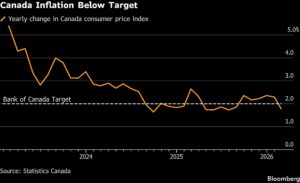
Canadian inflation decelerates to 1.8% on base effect

Latest News

Posted by: Dean Kimoto

Canada’s inflation rate slowed by more than expected last month after a sales tax break rolled out of yearly comparisons.

                 A shopper walks through St. Lawrence Market in Toronto.

By Nojoud Al Mallees

(Bloomberg) — Canada’s inflation rate slowed by more than expected last month after a sales tax break rolled out of yearly comparisons.

Headline inflation fell to 1.8% in February from 2.3% in January, Statistics Canada reported on Monday. That’s lower than the 1.9% expected by economists surveyed by Bloomberg.

A temporary sales tax break introduced by former prime minister Justin Trudeau on a range of goods, including restaurant meals and children’s toys, expired in the middle of February last year.

While the tax holiday initially drove yearly headline inflation higher because of base effects, it’s now reversing and causing a deceleration that will likely affect March inflation data as well.

Core measures of inflation also eased by more than expected in February. The consumer price index excluding food and energy was up 2%, while the central bank’s median and trim measures of inflation both fell to 2.3%.

Canada bonds rallied across the curve, with the two-year yield down 6.3 basis points to 2.725% as of 9:14 a.m. in Ottawa.

Shelter prices continued to decelerate last month, and were up just 1.5% from a year ago, the slowest pace in five years amid weak housing resales and smaller rent price increases.

Prices for food — which has been a major sore spot for Canadian consumers — also rose at a slower rate. Yearly inflation on food purchased from stores was 4.1% in February from 4.8% the previous month. The deceleration was led by weaker price growth for frozen or fresh beef.

Still, grocery prices are up a cumulative 30.1% over the past five years.

Meanwhile, a more modest year-over-year deceleration in gasoline prices last month moderated the slowdown in headline inflation, with prices at the pump down 14.2% compared to 16.7% in January.

Gasoline prices were up 3.6% on a monthly basis, largely driven by an increase in oil prices ahead of the Middle East conflict and oil supply disruptions in some producer countries, Statcan said.

Andrew DiCapua, an economist at the Canadian Chamber of Commerce, said higher oil prices from the conflict in Iran are likely to show up in next month’s data too.

“For the Bank of Canada, the signals remain mixed with jobs data and inflation pulling them in different directions. That uncertainty for now will likely keep the Bank on hold at this week’s meeting as it waits for a clearer picture,” DiCapua said in an email.

On Friday, Statistics Canada reported the country lost 83,900 jobs in February, the biggest decline in more than four years.

Policymakers are widely expected to keep the benchmark interest rate unchanged at 2.25% on Wednesday.

–With assistance from Mario Baker Ramirez.

©2026 Bloomberg L.P.

This article was reposted from the Canadian Mortgage Trends website.

5 Mar

Slower housing market mixed blessing for those looking to move up property ladder

Latest News

Posted by: Dean Kimoto

A cooling housing market has been good news for those looking to buy their first home, but for homeowners looking to move up the property ladder, the slowdown is more of a mixed blessing.

By Craig Wong, re posted from the Canadian Mortgage Trends website

If you need to sell a home and buy another, the easing in the market adds complexity to your decision.

Davelle Morrison, a broker at Bosley Real Estate Ltd. Brokerage, says it depends on your local market when deciding whether to sell your home first or find your next home and then put your current place up for sale.

“It is important to recognize what kind of market that you’re in, in terms of whether you buy first or sell first,” she said.

“Right now, we’re in that kind of a market where it really does make sense to sell first.”

If you’re looking for a house to buy, a slower market means there will be less of a chance that you’ll find yourself in a bidding war for your new home. That’s good news for potential homebuyers who faced a red-hot market just a few years ago.

But most homeowners need the proceeds from the sale of their current home to make the down payment on the new one and the easing in the market also means it might be harder or take longer than expected to sell your existing property.

That means if you have an offer accepted on a new place without a deal to sell your current home, you’ll have to find a way to bridge the transition financially or delay the closing of the deal until you sell if you don’t want to lose out on the new place.

But if you sell first and close on the sale before you find a home you love to move to, you could find yourself scrambling to find somewhere to lay your head until you find somewhere new to call home.

Morrison said it is important to honest with yourself when it comes to the process of finding a new place.

“If you’re the kind of person who’s extremely, extremely picky and you’re looking for something that’s really specific that doesn’t come out on the market very often, you might need to consider buying first because you might not find what you need if you sell first,” she said.

If that’s the case, Morrison said it is important to take steps to protect yourself.

If you find your dream home before you have a signed deal on your own home and still want to make an offer, she says you’ll want to consider making your offer conditional on the sale of your home.

Anne Alkok, the broker of record at Wahi Realty Inc., said in a hot market a seller might be unwilling to accept such a restriction, but a Realtor can help you understand the current market in your area.

“You do have to be familiar with the market conditions,” she said.

Bridge financing might also be an option, but you’ll have to check with your lender to see if you qualify in addition to qualifying for your mortgage.

A short-term loan to buy your new home before the old one sells could be an option, but it will add costs as interest rates are typically higher than in conventional lending.

Alkok said if your budget is tight and your next purchase depends heavily on what you net from the sale, selling first will give you a clear idea of how much you’ll be able to afford when making your own offer.

Whereas, she says, if you are in a stronger financial position, then you might have more flexibility. “But carrying properties even temporarily does cost money. So it does have to be planned carefully,” she said.

Alkok said there isn’t one choice that works for everyone and it is important to know what you are comfortable with.

“Some people want the certainty. They want to know exactly what their home sells for before they shop. Other people are comfortable making a move first because they’re confident that their home will sell and that they have the financial flexibility to manage the timing.”