15 Jul

Bank of Canada maintains the policy rate at 2¼%

General

Posted by: Dean Kimoto

The Bank of Canada today held its target for the overnight rate at 2.25%, with the Bank Rate at 2.5% and the deposit rate at 2.20%.

Canada’s economy is showing signs of improvement. Growth is picking up and inflation is projected to ease gradually from its recent spike. There are still important risks and uncertainties related to the war in the Middle East and US trade policy.

Since the April Monetary Policy Report (MPR), global economic prospects have been dented by higher oil prices stemming from the Middle East conflict. At the same time, the build-out of artificial intelligence (AI) is supporting economic activity in a growing number of countries. Oil prices are still lower than their peak in April but the situation in the Middle East remains volatile. The path for global inflation is highly dependent on how the conflict unfolds.

The US economy is growing at about 2½%, mostly because of strong consumption and booming AI investment. China’s economy is expanding solidly thanks to robust exports. Economic activity in the euro area has been weighed down by high energy prices, but is expected to strengthen in the second half of the year if energy prices come down as anticipated.

The Bank projects global GDP growth will slow to 2¾% in 2026, mostly because of the effects of the Middle East conflict, and recover to around 3¼% in 2027 and 2028.

Financial conditions in Canada have eased since April and global equity markets have been buoyant. US bond yields have risen, while those in Canada are little changed. This differential has contributed to the depreciation of the Canadian dollar.

Canada’s GDP data over the past year was choppy and growth stalled as the economy adjusted to new tariffs, high uncertainty and slower population growth. Labour market conditions have remained soft, reflecting ongoing economic slack. The unemployment rate was 6.5% in June and has hovered in a range of 6½%-7% since the end of 2024. There are clear signs that economic growth has resumed in the second quarter, with growth estimated at 2½%. While this largely reflects the unwinding of temporary factors, sources of economic growth appear to be broadening.

Recent indicators point to continued solid consumer spending. Housing activity has been weak but looks to be stabilizing. Export growth has resumed and is expected to continue to strengthen, albeit on a lower path. Business investment is projected to pick up modestly, boosted in the near term by the oil and gas sector. Although the Canada-US-Mexico Agreement is now subject to annual reviews, more businesses report they are finding ways to navigate through the uncertainty. Government spending also contributes to higher economic activity over the projection.

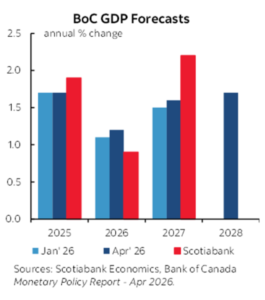
Following GDP growth of 0.7% in 2026, the Bank projects the economy will grow by 1.8% in both 2027 and 2028. As the recovery proceeds, economic slack will be gradually absorbed.

CPI inflation rose further to 3.2% in May, mainly because of higher gasoline prices linked to the war in the Middle East. Excluding gasoline, inflation was 2.2% and measures of core inflation remained close to 2%. Near-term inflation expectations are sensitive to changes in gasoline prices but longer-term inflation expectations remain well anchored. War-related cost pressures are still working their way through some consumer prices but are being offset by downward pressure on other prices from continued economic slack. CPI inflation is expected to stay elevated in June and then ease gradually in the coming months, returning to around 2% in early 2027, although this forecast is dependent on the path for oil and gasoline prices. Inflation is forecast to average around 2% in 2027 and 2028, albeit with some monthly fluctuations because of base-year effects.

Governing Council judges the current policy rate remains appropriate to sustain the economic recovery and bring inflation back to the 2% target, in line with the MPR projections. Uncertainty is still high. Governing Council will continue to assess the strength of the Canadian economy and the outlook for inflation, and is prepared to adjust monetary policy as needed. The Bank is committed to maintaining Canadians’ confidence in price stability through this period of global upheaval.

Information note
The next scheduled date for announcing the overnight rate target is September 2, 2026. The Bank’s next MPR will be released on October 28, 2026.

This media release is reposted from the Bank of Canada website.

14 Jul

Bank of Canada expected to hold as debate shifts to timing of rate hikes

Latest News

Posted by: Dean Kimoto

The Bank of Canada is widely expected to hold its policy rate at 2.25% this week, but economists remain divided over how soon the central bank may need to begin raising rates.

The Bank of Canada is expected to keep its policy rate unchanged at 2.25% on Wednesday, which would mark a sixth consecutive hold.

With a hold now largely priced in, the more consequential question is whether the Bank’s updated forecasts and accompanying language begin to lay the groundwork for rate hikes later this year.

That debate has sharpened as the economy shows signs of recovering from a weak start to 2026, even as inflation remains uncomfortably high. Headline inflation has climbed above 3%, driven largely by higher energy costs, while recent GDP and employment data suggest the economy may be emerging from its early-year soft patch.

BMO senior economist Benjamin Reitzes said the bar for a move in either direction remains high. The recent improvement in economic data gives the Bank little reason to cut, while continued slack in the economy should keep policymakers from rushing to raise rates.

“The economic data have turned up recently following a miserable run,” Reitzes wrote. However, he said the economy’s persistent output gap should continue to generate disinflationary pressure and limit the Bank’s willingness to tighten policy.

He said lower oil prices should ease some of the Bank’s immediate concerns, but policymakers will continue watching for signs that higher energy and transportation costs are spreading more broadly. With the 2021-to-2023 inflation surge still fresh, the key issue is whether the rise in headline inflation proves temporary or begins to influence wages, inflation expectations and the wider consumer price basket.

Updated forecasts could reveal a more hawkish tilt

The Monetary Policy Report, which sets out the Bank’s updated forecasts for growth and inflation, may offer a clearer signal than the rate announcement itself.

Scotiabank economist Derek Holt expects the Bank to mark down its first-quarter outlook after GDP contracted slightly rather than expanding as forecast. That weakness may be offset by a stronger rebound in the second quarter, which Holt estimates may have exceeded 2%, above the Bank’s April projection of 1.5%.

“The BoC may need to revise down its 2026 GDP growth forecast in marked-to-market fashion after Q1 GDP disappointed,” Holt wrote, adding that a stronger second quarter could provide a partial offset.

Scotiabank says inflation remains the tougher part of the outlook, with headline CPI reaching 3.2% in May—above the Bank’s projected 3% peak—and a weaker Canadian dollar, elevated input costs and firmer short-term core measures still pointing to upside risk despite lower oil prices.

Holt said the Bank may need to revise its 2026 inflation forecast upward, arguing that Canada appears to be moving out of its winter “inflation soft patch.”

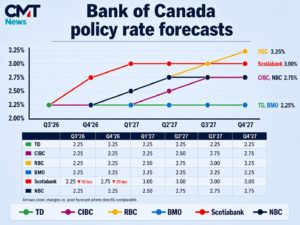
Scotiabank sees those pressures eventually pushing the Bank to withdraw some stimulus, with two quarter-point hikes expected before year-end and a third in early 2027. That would take the policy rate to 2.75% by December and 3% shortly thereafter.

Big banks differ mainly on when hikes begin

The latest forecasts show a growing divide over how long the Bank can remain on hold—and how quickly rates may rise once tightening begins.

TD and BMO expect the policy rate to stay at 2.25% through the end of 2027. CIBC and National Bank see hikes beginning next year, while RBC projects a more gradual tightening cycle that takes the rate to 3.25% by the end of 2027.

Scotiabank remains the most aggressive forecaster, with hikes beginning in the fourth quarter of this year and the policy rate reaching 3% in early 2027.

This article was written for Canadian Mortgage Trends by:

Steve Huebl

Steve Huebl is a graduate of Ryerson University’s School of Journalism and has been with Canadian Mortgage Trends and reporting on the mortgage industry since 2009. His past work experience includes The Toronto Star, The Calgary Herald, the Sarnia Observer and Canadian Economic Press. Born and raised in Toronto, he now calls Montreal home.

8 Jul

Buy now or wait? Canadians see no easy answer in housing market

General

Posted by: Dean Kimoto

A new RBC poll finds most Canadians believe there is no perfect time to buy, as economic uncertainty, affordability pressures and rate expectations complicate purchase decisions.


Most Canadians say there is no perfect time to buy a home, according to a new RBC poll that points to the uncertainty still hanging over the housing market despite some improvement in affordability.

The survey found that 64% of Canadians agree “you can never really know when the right time is to buy a home,” while 73% said economic uncertainty is making it difficult to know when to act.

The results suggest many would-be buyers are still struggling to read the market after several years of sharp rate hikes, elevated home prices and uneven regional conditions. While lower borrowing costs have helped restore some purchasing power, homeownership remains stretched for many households.

RBC’s latest national affordability measure improved to 53% in the first quarter of 2026, its best level in four years. The measure tracks the share of a median household’s pre-tax income needed to cover ownership costs, meaning a lower reading points to improved affordability.

But RBC also cautioned that affordability gains are becoming weaker and less broadly felt across the country, with some markets still seeing ownership costs rise. “Further easing in affordability could get slimmer as price declines taper off, and interest rates have likely passed cyclical lows, limiting reductions in mortgage costs,” the bank said

Buyers see opportunity, but confidence remains weak
Among Canadians who intend to buy a home within the next two years, 45% said now is the right time to buy, compared with 27% of Canadians overall.

But that sense of opportunity is being tempered by uncertainty. Among prospective buyers, 75% said economic uncertainty is making them more cautious, while 72% called it the biggest challenge to buying a home.

The Bank of Canada has held its policy rate at 2.25% since December, including at its June decision, but borrowers continue to face mortgage rates well above the ultra-low levels seen earlier in the decade.

RBC’s poll also found that 78% of Canadians believe homeownership requires more sacrifices today than it did for previous generations, while just 28% said they feel confident making homebuying decisions in today’s market.

Other findings from the poll include:

58% of prospective buyers said lower home prices will allow them to buy their first or next home.
54% said lower interest rates will help them enter the market.
53% said there is only a small window to take advantage of lower prices before they rise again.
69% expect to delay major purchases, such as a car or renovations.
62% expect to postpone or scale back vacations.
60% said they need to completely overhaul their spending and saving habits.
53% said they may need to put some retirement savings toward buying a home.
40% of Canadians said they have the information they need to make smart homebuying decisions.


This article was written by the CMT team on July 8, 2026.