5 Jan

Canadian seniors are selling their homes later in life. What will this mean for the housing market?

General

Posted by: Dean Kimoto

A recent report has found Canadian seniors are choosing to age in their homes for longer, with many not selling their home until their 80s and 90s.

The findings were revealed in the Housing Market Insight Report by the Canada Mortgage and Housing Corporation (CMHC), which explored some of the expected implications on housing supply in the coming years.

According to the CMHC, more seniors are potentially staying homeowners well into their later years because many are simply living longer, healthier lives and can handle the maintenance of a home.

The study, which focused on elderly Canadian households in the country’s six largest cities, also identified differences based on location. For example, households in Toronto and Vancouver are the most likely to transition to condominiums as they age, where in Montreal there’s a preference for moving to rental housing.

“In Canada, the financial wealth of elderly households may also vary from one urban centre to another,” says the CMHC in its report. “Affluent households may therefore be able to remain homeowners and purchase a home that meets their needs, rather than rent one.”

Canadian seniors are most likely to sell in their nineties

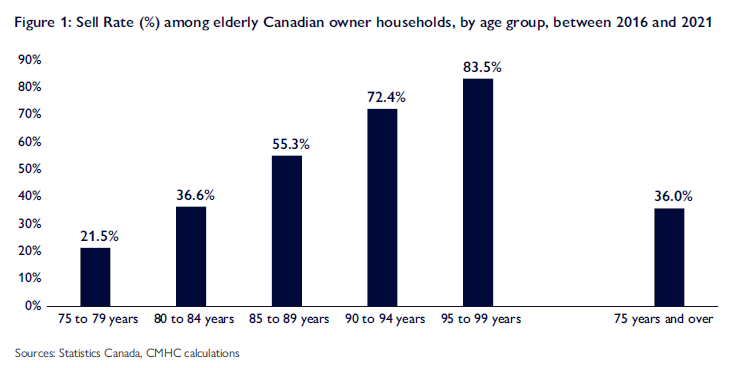
Canadian household census data show an estimated exponential sell rate trend amongst seniors from 2016 to 2021. Following consecutive cohorts over time, the data show a higher prevalence of significantly older seniors selling or giving up their homes compared to younger seniors.

CMHC defines the sell rate as the ratio of homeowners who sold their properties to the total number of homeowners for that particular demographic. For example, between 2016 and 2021, 100,500 homeowners aged 75 to 79 let go of their properties out of an initial total of 466,775 owner households, resulting in a sell rate of 21.5%.

CMHC adds that the sell rate for households aged 75 and above has been trending downward since the early 1990s, falling on average six percentage points in that time.

Based on these calculations, the data show most Canadians wait until they’re in their nineties to give up their home.

Cohorts that are approaching or in their 90s are expected to sell their homes and potentially open up additional housing supply to the market in the coming years.

“They might, for example, decide to rent private housing or, for health reasons, move into public housing (such as a care centre for seniors),” the CMHC report says. “Deaths are another factor that brings properties onto the market.”

What does this mean for Canadian housing availability?

While CMHC says it will still take a few years to have older seniors list their homes on the market, the result has the potential to eventually increase housing supply and subsequently narrow the affordability gap in Canada.

The result “seems to indicate that the number of units sold by elderly households might increase more rapidly once population aging in Canada is more advanced,” CMHC said. “In other words, when the number of households over age 85 grows larger.”

According to projections from Statistics Canada, population growth in the 85-and-over age group will rise more rapidly from 2030 to around 2040 due to the first baby boomer cohorts reaching this age group.

For now, it may be a waiting game to see if and when housing supply increases as expected.

“The big question is whether, in the coming decades, elderly households will follow in the footsteps of previous generations or go their own way,” says CMHC. “For example, will aging in place become more popular with seniors? Will the recent rise in rental housing starts in various CMAs across the country encourage more senior households to opt for renting?”

Until then, restoring housing affordability in Canada will largely depend on how senior household sales unfold in the near future.

22 Dec

Bank of Canada’s confidence grows that rates are now high enough, but says inflation risks remain

General

Posted by: Dean Kimoto

The Bank of Canada’s six-member Governing Council believes the odds have increased that interest rates are now high enough to bring inflation back to target.

That’s according to a summary of the council’s deliberations from its December 6 monetary policy meeting.

“Members agreed that the likelihood that monetary policy was sufficiently restrictive to achieve the inflation target had increased,” the summary reads. But they also noted that upside inflation risks remain, and are therefore not prepared to rule out further hikes.

The members agreed that the Bank’s 475 basis points of rate hikes since March 2022 are continuing to work their way through the economy and are now slowing spending and easing price pressures.

“With the economy no longer in excess demand, members agreed they would be watching for signs that the slowdown in the economy was translating into further and sustained easing in inflation,” the summary said.

However, they cited ongoing concerns about the speed at which inflation was easing. Specifically, they pointed to the three-month annualized measure of core inflation, which has “remained stuck” at between 3.5% and 4% for nearly a year.

They also expressed concern that wages have continued to increase at between 4% and 5%. “If this were to continue, it would not be consistent with achieving price stability, particularly given weak productivity,” the summary reads.

As a result, members said they want to see more evidence that both of these indicators are trending “in a direction that is consistent with price stability.”

Governing council split on where home prices are headed

The council also discussed the current monetary policy’s impact on house prices.

Some members said they believed house prices would continue to ease as high interest rates continue to “weigh on the housing market.”

Others said they were concerned that prices could continue to rise due to the mismatch between housing supply and demand, and the time needed to bring new supply online.

“Members noted that if financial conditions eased prematurely, the housing market could rebound, further fuelling shelter price pressures,” the summary noted.

The members also “discussed at length” the acceleration of shelter price inflation, which in October rose at a pace of 6.1%, contributing a full 1.8 percentage points to the overall headline inflation reading of 3.1%.

The council acknowledged that higher mortgage rates are “clearly playing a role” in shelter price inflation, but also noted strong growth in rent and other components linked to housing, such as insurance, taxes and maintenance, which they said was “unusual.”

The Bank of Canada’s next policy meeting is scheduled for January 24, 2024.

This article was written for Candian Mortgage Trends by:
15 Dec

Mortgage de-selection: Can your lender choose not to renew your mortgage?

General

Posted by: Dean Kimoto

In its third-quarter earnings call, Scotiabank said it was undertaking a strategy of “customer de-selection at renewal” as part of its efforts to slow its mortgage growth and be more selective of its client base.

“I think this is a good time to drive that standard higher here because it’s a softer, slower housing market,” said Dan Rees, head of Canadian Banking. “We are also being more efficient with regards to our use of capital and using customer deselection at renewal as part of that conversation.”

With an estimated three million Canadians facing a mortgage renewal over the next 15 years, that comment has raised a very important question for many borrowers: does my lender have to renew my mortgage?

Is your mortgage renewal guaranteed?

For a little bit more context, we reached out to some mortgage professionals.

“If the mortgage is up to date, if the payments are up to date, then some renewal will be offered to the homeowner. That’s the general policy of these organizations,” says Ron Butler of Butler Mortgage.

While this is a typical practice among federally regulated banks, Butler points out that provincially regulated credit unions also tend to follow the same guidance.

From Butler’s perspective, borrowers might be refused renewal if there were major violations of the contract such as rebuilding the home without permission, or if the homeowner ended up in prison.

Frances Hinojosa, CEO of Tribe Financial, adds that there are sometimes other risk factors that lenders may consider.

“I think there’s this misconception that when we come up for renewal, the banks are going to renew regardless. And that’s not necessarily the case,” Hinojosa said.

Lenders may review multiple factors, such as the current loan-to-value (LTV) ratio or the prevailing economic environment, when they’re assessing the risk of that client, she added.

A potential misinterpretation

While “mortgage de-selection” evokes images of a lender simply refusing to renew a client’s mortgage, the process is actually more nuanced.

In no uncertain terms, Butler said the chance of Scotiabank—or any other major lender—choosing not to renew clients is a very low probability.

“I have seen nothing at all that would indicate that Scotia is sending people notices that they will not renew their mortgage,” he told CMT.

Matthew Imhoff, founder of Meticulous Mortgages, says the process more often involved a renewal offer that’s simply not appealing to the client.

“When I look at the banks, the deselecting is more [about] offering a rate that the bank is willing to accept to keep the client,” he said.

It’s also important to note that Scotiabank has been very open about its strategy to scale down its mortgage book in order to focus more on growing its deposits, whereas the other major lenders are typically still looking for both origination growth and customer retention.

A riskier rate environment

But with hundreds of billions of dollars in mortgages coming up for renewal at higher interest rates, and banks setting aside large amounts of funds in preparation for a rise in delinquencies, Hinojosa says all lenders are carefully assessing risk.

They’re also having to balance regulatory requirements that now require them to keep additional capital on hand in the event of potential future losses. On Friday, for example, the Office of the Superintendent of Financial Institutions (OSFI) maintained its Domestic Stability Buffer—a kind of “rainy day fund”—at 3.5% of risk-weighted assets. This is in addition to minimum capital requirements for Canada’s Big 6 banks to keep on hand at least 11.5% of risk-weighted assets.

“We’re seeing more complexity around [the interest rates lenders offer] especially now when we’re in a lending environment where there’s higher capital requirements,” Hinojosa said. “[Lenders] are looking more at risk levels, they’re forecasting out for if there are going to be any potential defaults.”

Additionally, Butler views the use of the term deselection to express Scotiabank’s desire to “maintain the kind of margins they felt they needed to make on mortgages,” he indicates.

In an email to CMT, Scotiabank clarified Rees’ comment from Scotia’s earnings call.

“Our mortgage portfolio remains strong and when a mortgage comes up for renewal, we continue to be committed to providing our mortgage customers with appropriate renewal options based on their individual needs and financial goals.”

5 Dec

Residential Mortgage Commentary – BoC likely to hold the line

General

Posted by: Dean Kimoto

Two key guide posts for the Canadian economy are pointing in the same direction.  Both the third quarter GDP numbers and November jobs figures suggest the Bank of Canada is unlikely to make any changes to its trendsetting interest rate in the coming days.

Canada’s economy shrank at an annualized rate of 1.1% through July, August and September.  That was a bigger decline than expected.  Market watchers had been looking for a modest 0.2% increase.  The Bank of Canada had forecast a 0.8% gain.  The country avoided falling into a technical recession though, because the Q2 reading was revised upwards to a 1.4% gain.  It had initially been posted as a 0.2% decline.  Nonetheless the economy has been on a slowing trend for several months.

The economy added more jobs than expected in November, but the unemployment rate went up.  There were nearly 25,000 jobs added, beating the forecast of 15,000.  However, that did not keep up with the country’s population growth.  Unemployment rose to 5.8%, from 5.7% in October, because there are more people looking for work.

These are the last two major economic data points before the Bank of Canada makes its December rate announcement this week.  When combined with the latest inflation numbers (up 3.1% y/y in October) the Bank appears to have all the reasons it needs to hold its policy rate at 5.0%.  That rate has not moved since July and the market focus has now shifted away from further increases and toward when there could be cuts.


This article was written by the First National Financial LP Marketing Team, click here for the original post.

4 Dec

Some mortgage clients could see up to 40% payment increases at renewal, BMO says

General

Posted by: Dean Kimoto

Like most other financial institutions, BMO said the bulk of its mortgage portfolio will be up for renewal in the coming three years, with the payment increases averaging up to 40%.

In its fourth-quarter earnings call, the bank said just 11% of its portfolio—or $16.2 billion worth—will renew in the next 12 months. The majority is then set to renew in 2025 ($27.6 billion) and 2026 ($55.8 billion).

Of its clients who have already renewed their mortgages, BMO said the average increase to their regular payments has been 21% for fixed-rate borrowers and 22% for those with variable-rate mortgages. Given that those are averages, some borrowers have seen smaller increases while others have seen their payments rise by more.

And as those who secured rock-bottom rates during the pandemic start to see their rates reset in the coming years, BMO says the payment increases will grow larger.

“We do see people having to face a 30% increase this year,” said Ernie Johannson, Head of BMO North American Personal and Business Banking. “That will get higher as we move into ’26 because—if you assume no rate decrease—there would be customers who would potentially be facing 35% or 40%, at that tail end.”

Despite the increases, BMO says borrowers have so far been able to handle the higher rates.

“We’ve seen an ability for consumers to adjust and be able to afford the increased payment,” Johannson added, noting that they were stress tested at a higher rate at origination and that many are also seeing an increase in income that is helping to offset the higher payments. “We feel pretty confident that there is an…ability to be able to handle that increase.”

Rate cuts could also lessen the payment shock for renewals taking place in 2026, added Chief Risk Officer Piyush Agrawal.

“A larger portion of our portfolio renews in 2026, by which time we expect interest rates will have moderated and customers will have had time to prepare,” he said.

Delinquency rate remains low, and clients still have payment buffers

BMO reported that its 90+ day mortgage delinquency rate remains low at just 0.14% of its portfolio, unchanged from the previous quarter and up from 0.11% a year ago.

Of its variable-rate mortgage portfolio, the bank said about 62%, or $29.8 billion worth, are currently negatively amortizing, meaning the monthly payments aren’t enough to cover the total interest cost, which is being added to the principal balance.

This is a situation unique to fixed-payment variable rate mortgage products, which are offered by BMO, CIBC and TD. While RBC also offers fixed-payment variable rate mortgages, it does not allow its mortgages to amortize negatively.

“We are proactively reaching out to customers, particularly our variable-rate customers,” said Agrawal. “We’ve had a positive customer response to the outreach, resulting in a reduction in mortgages in negative amortization from the prior quarter.”

Agrawal also said the bank’s analytical insights show clients are changing their behaviour and are “adjusting to the new reality” of higher interest rates. That includes a decline in credit card spending, particularly for discretionary items.

He also pointed to a still strong savings rate of 5%, with increased amounts going into investments. “So, there are buffer mechanisms,” he noted.

The bank has also seen the percentage of its mortgages with amortizations above 30 years ease back to 27%. That’s down from nearly a third of its portfolio in late 2022.


Remaining amortizations for BMO residential mortgages

Q4 2022 Q3 2023 Q4 2023
16-20 years 13.5% 13.4% 13.6%
21-25 years 32.3% 31.6% 32.1%
26-30 years 13.8% 15.8% 18%
30 years and more 31.3% 29.8% 27%
Remaining amortization is based on current balance, interest rate, customer payment amount and payment frequency.

BMO earnings highlights

Q4 net income (adjusted): $2.15 billion (+0.1% Y/Y)
Earnings per share (adjusted): $2.81

Q4 2022 Q3 2023 Q4 2023
Residential mortgage portfolio $139.4B $135.5B $150.6B
HELOC portfolio $47.3B $48.5B $48.7B
Percentage of mortgage portfolio uninsured 69% 71% 71%
Avg. loan-to-value (LTV) of uninsured book 52% 55% 54%
Mortgages renewing in the next 12 months $23B $21B $16.2B
% of portfolio with an effective amz of <25 yrs 55% 54% 55%
90-day delinquency rate 0.11% 0.14% 0.14%
Canadian banking net interest margin (NIM) 2.72% 2.77% 2.77%
Provisions for credit losses $226M $492B $446M
Source: BMO Q4 Investor Presentation

Conference Call

  • BMO reported that its capital position continued to strengthen with a common equity ratio of 12.5%, up 20 basis points from the prior quarter.
  • “Given our current outlook for higher for longer rates and the lagged impact from these interest rate increases, we expect impaired loss rates to trend somewhat higher from Q4 levels in the range of low-30 basis points, still below our long-term average and then improve as the rate start to come down and the economy begins to strengthen further,” said Chief Risk Officer Piyush Agrawal.
  • “Given our strong risk management capabilities, the quality of our portfolio and prudent allowance coverage, we remain well-positioned to manage current and emerging risks,” Agrawal added.

Source: BMO Q4 conference call


Note: Transcripts are provided as-is from the companies and/or third-party sources, and their accuracy cannot be 100% assured.


This article was written for Canadian Mortgage Trends by:

1 Dec

Not quite a recession, but Canada sees third-quarter growth turn negative

General

Posted by: Dean Kimoto

There was growing talk of the “R-word” (recession) leading up to today’s GDP data release, given the third quarter could have marked the second straight month of negative growth.

Instead, markets received another R-word…revision.

While Statistics Canada revealed that real gross domestic product (GDP) fell 0.3% quarter-over-quarter in Q3, it also revised up its previous negative reading for Q2 to positive growth of 0.3%.

This avoided two straight quarters of declining GDP, which many consider the technical definition of a recession.

“Whatever label you slap on this economy, it’s basically not growing, despite the artificial sweetener of rapid population growth,” noted BMO Chief Economist Douglas Porter.

“But reinforcing the point that it doesn’t quite sink to the level of recession, the initial read on monthly GDP for October was a surprisingly perky +0.2%, confounding expectations that activity would shrink in Q4,” he added.

“It’s not a technical recession, but it’s not good either,” wrote TD’s James Orlando.

Economy is weak no matter how you slice it

On an annualized basis, GDP fell less than expected by 1.1% in Q3. That followed an upward revision in Q2 to +1.4% from -0.2% previously.

Housing investment was a positive contributor to growth in the quarter, rising +8% quarter-over-quarter following five straight quarterly declines.

“Still, the details of the Q3 data were soft—GDP would have declined a larger 3% in the quarter without a 7.3% jump in government spending,” noted RBC’s Nathan Janzen.

Meanwhile, international trade was a net negative for growth, with exports of goods and services down 5.1% from the previous quarter, led by a 25.4% drop in refined petroleum energy products.

Imports were also down by 0.6%, led by “declines in clothing, footwear and textile products, transportation services, and electronic and electrical equipment and parts.” Household spending was flat in the quarter, following a similar flat reading in Q2.

GDP figures reinforce a BoC rate hold, but too soon for cuts

Today’s results are expected to keep the Bank of Canada on the sidelines at its net monetary policy meeting next week, and into the new year.

Economists say continued weak growth in the coming quarters should help bring inflation back to (or near) the central bank’s target of 2%.

“Overall, today’s mixed report reinforces the point that the Bank is done hiking rates, but doesn’t really advance the cause for rate cuts, as the economy isn’t showing signs of further deterioration early in Q4,” said Porter.

Others believe continued weak growth will be enough to herald in the central bank’s first rate cuts as early as April of next year.

“We expect below trend economic growth to continue over the coming months, which will push inflation gradually closer to the 2% target,” noted Orlando. “This will give the BoC a few months before it starts to prepare markets for rate cuts, which we expect will start in April 2024.”

CIBC’s Andrew Grantham agreed, saying the “sluggish trend in economic activity and further decline in the job vacancy rate today keeps us on track for a first interest rate cut in Q2 next year.”


This article was written for Canadian Mortgage Trends by:

29 Nov

Latest in mortgage news: Adult children of homeowners twice as likely to own a home

General

Posted by: Dean Kimoto

A key factor in determining whether an individual is likely to become a homeowner is whether or not their parents were property owners, a new study shows.

The adult children of homeowners were more than twice as likely to own a home compared to the children of non-owners, according to findings released by Statistics Canada last week.

The report found that children of non-homeowners had an overall homeownership rate of 8.1% vs. 17.4% for the offspring of owners. The correlation increased in families that owned multiple properties, rising to a homeownership rate of 22% for those whose parents owned two properties and 27.8% for those whose parents owned three or more.

The study, which focused on those born in the 1990s and compared ownership rates as of 2021, found the positive association between the homeownership rate of adult children and their parents was greatest among adult children with individual incomes of $80,000 or less.

“The income of adult children may be correlated to the income and wealth (including property ownership) of their parents, in part because of patterns of childhood socialization, existing social networks and the amounts invested in education, the report notes.

However, even when accounting for the adult children’s age, income and province of residence, parents’ property ownership is “strongly associated with an increased likelihood of homeownership for their adult children,” it added.

MBRCC unveils principles for mortgage product suitability

Mortgage brokers across the country are being asked to follow a set of six principles to ensure they are making suitable product recommendations to their clients.

In an ongoing effort to strengthen mortgage consumer protections, the Mortgage Broker Regulators’ Council of Canada (MBRCC) last week unveiled its final Mortgage Product Suitability Assessment Principles.

“Given high interest rates, elevated inflation and reduced mortgage affordability, many consumers are looking to the mortgage brokering sector for sound advice,” said MBRCC chair Antoinette Leung. “The Principles developed by MBRCC will support the industry’s provision of suitable recommendations to clients, enhancing the protection of Canadian consumers during a period of challenging financial conditions.”

The draft principles were first released over the summer, and the MBRCC since made two amendments following public feedback.

The mortgage product suitability assessment principles include:

  1. Know your client
  2. Know your product
  3. Assess options and make suitable recommendations
  4. Clearly communicate and explain rationale of the recommended option
  5. Ensure adequate oversight and accountability
  6. Document suitability assessment and oversight

More details on the above principles are available at the MBRCC website.

FSRA releases guidance for mortgage administrators

Effective today, mortgage administrators in Ontario must comply with new rules that govern financial reporting.

The new guidance was released by the Financial Services Regulatory Authority of Ontario (FSRA), which regulates and licences all mortgage brokers, agents, brokerages and administrators in the province.

“Mortgage administrators play the crucial role of handling people’s funds and investments, and we want to ensure that borrower and investor funds are protected,” Huston Loke, Executive Vice President, Market Conduct at FSRA, said in a release. “The guidance we are releasing today aims to reduce the risk of funds and investments being misplaced, stolen, or otherwise treated improperly.”

The guidance will help ensure:

  • administrators file the required statements and auditor’s reports on time
  • the auditor’s report is certified by a licensed public accountant
  • the auditor’s Reasonable Assurance report on compliance with legislation is in a form approved by the CEO and addresses all the required areas of compliance

The full text of FSRA’s new guidance is available here.

Pineapple Financial completes IPO on New York Stock Exchange

Pineapple Financial made history recently by becoming the first Canadian mortgage brokers to launch an Initial Public Offer (IPO) on the New York Stock Exchange (NYSE).

Founded in 2016, Pineapple is a tech-focused brokerage with a network of over 650 partner brokers and agents across the country. It said it will use the capital raised from the IPO to fund research and development and expansion into new product offerings and tech infrastructure.

That includes expanding to every province in the country, adding insurance as a new product offering, and developing digital innovation to “increase productivity and efficiency” across all of its channels.

“The decision to go public was driven by our vision to expand market reach, accelerate growth initiatives, and capitalize on new opportunities,” Pineapple CEO and co-founder Shubha Dasgupta said in a release. “With this successful IPO, Pineapple achieved a milestone that reflects its market potential, growth trajectory, and our commitment to excellence.”


This article was written for Canadian Mortgage Trends by:

19 Nov

Four big banks to be impacted by OSFI’s new capital requirements for negative amortization mortgages

General

Posted by: Dean Kimoto

Canada’s banking regulator recently confirmed it will move ahead with new capital requirements for lenders and insurers with negatively amortizing mortgage portfolios.

Starting in early 2024, the Office of the Superintendent of Financial Institutions (OSFI) will require lenders to hold more capital for negative amortization mortgage balances with loan-to-values (LTVs) above 65%.

  • What’s a negative amortization mortgage? Negative amortization can impact borrowers with fixed payment variable-rate mortgages in an environment when prime rate rises significantly, resulting in the borrower’s monthly payments not covering the full interest amount. This causes the mortgage to grow rather than shrink.

“We have updated several of our capital guidelines to promote prudent allocation of capital against risks that lenders and insurers take,” OSFI superintendent Peter Routledge said in a statement.

The changes were first announced by OSFI in July and were subject to a consultation period over the summer. They will primarily impact four of Canada’s big banks that currently offer fixed-payment variable rate mortgages: BMOCIBCRBC and TD.

For these banks, variable-rate mortgages comprise about a third of their overall portfolios (32%-39%), with roughly a quarter of those mortgages with extended amortizations beyond 30 years—or some $277 billion as of July, according to data from Fitch Ratings.

Scotiabank and National Bank of Canada, on the other hand, offer adjustable-rate mortgages where the borrower’s monthly payment fluctuates as prime rate changes. As a result, both banks have less than 1% of their variable-rate portfolios with amortizations above 30 years.

The new requirements will also impact Canada’s three mortgage insurers, which insure between 20% and 30% of all mortgages. Also effective in January, the maximum LTV ratio for individual mortgages in the Mortgage Insurer Capital Adequacy Test (MICAT) capital formula will increase from 100% to 105%. This adjustment aligns the MICAT capital formula with the maximum permitted LTV ratio for insured mortgages.

The new guidelines also set a limit of 40 years on the mortgage’s remaining amortization length for the purpose of calculating regulatory capital.

“Given the relatively low prevalence of negative equity mortgages, the overall impact for mortgage insurers is expected to be minimal, resulting in an immaterial decline in the capital ratio,” DBRS Morningstar noted in a report.

“Our expectation is that underwriting profitability will weaken somewhat but be manageable from a credit quality perspective given mortgage insurers’ strong capital buffers and conservative credit underwriting criteria,” the report added.

Impact on banks to be manageable, Fitch says

In its own report, Fitch said the Capital Adequacy Requirements (CAR) for the banks are likely to be “comfortably absorbed.”

The ratings agency said the changes should impact common equity tier 1 (CET1) ratios by only 7 to 22 basis points, “or less than 2% of the average 3Q23 13.5% CET1 capital for the four banks with exposure,” it said. “As of 3Q23, all banks had CET1 ratios comfortably above regulatory minimums.”

OSFI’s reasoning for cracking down on fixed payment variable-rate mortgages

OSFI has repeatedly voiced its concerns about fixed payment variable-rate mortgages, first singling them out in its Annual Risk Outlook for 2023-2024.

Most recently, during testimony before the Standing Senate Committee on Banking, Commerce and the Economy earlier this month, Routledge said increasing mortgage balances associated with negative amortization “increases their vulnerability, and increases the risk of default.”

“The variable rate product with fixed payments is a dangerous product in our view because it puts the homeowner in the position of an extended extended period—not always, but in this environment certainly—it can put the homeowner in the position of paying a flat rate of, say, $2,000 a month, and the interest on their mortgage is $3,000 a month,” Routledge said.

And while Routledge said OSFI’s role is not to “impose a judgment on product design,” he did say OSFI would “like less of that product.”

In response to stakeholder feedback on these new capital requirements that the implementation timeframe is “very tight,” OSFI responded by saying it was important to “address the risk in a timely manner.” As such, the new capital requirements will take effect in fiscal Q1.


This article was written for Canadian Mortgage Trends by:

14 Nov

Rent prices are up $175 in the past six months and have pushed rent inflation to a 30-year high

General

Posted by: Dean Kimoto

The average asking rent in Canada has increased by about $175 over the past six months, and is now nearly 10% higher compared to a year ago.

As of October, the average rent price for all unit types reached $2,178, according to data from Rentals.ca‘s latest monthly data. That’s up 1.4% compared to September, but slower than the 1.8% monthly increase seen back in August thanks to seasonable factors.

One-bedroom rent prices were up a whopping 29% year-over-year in Red Deer, Alberta, while Halifax, NS (+20.6%) and Markham, ON (+20%) also saw outsized gains.

The national average rent for two-bedroom units has now surpassed $2,300 a month, up 1.7% from September and +11.7% compared to a year ago. The largest increases were seen in Oakville, ON (+23.5%) and Quebec City, QC (+17.6%).

High rents are contributing to inflation

Average rents in Canada are now up over 31% compared to the low of $1,662 reached in April 2021.

This steep rise means rent prices are now a leading contributor to the country’s headline inflation rate, which the Bank of Canada is desperately trying to bring back to its target rate of 2%.

As of September, rent inflation has shot up to 7.3%, according to data from Statistics Canada—the fastest pace since 1983. It’s now the second leading contributor to overall inflation, after mortgage interest cost, which is up 30.6%.

On a monthly basis, rent inflation from August to September was 0.8%. That means that of the headline CPI inflation reading of 3.8% in September, 0.8% came from rent inflation alone. Another 2.6% came from mortgage interest cost.

“It’s a big issue,” noted analyst Ben Rabidoux of Edge Realty Analytics. He pointed to the more than 700,000 non-permanent residents added to the population over the past 12 months—which includes international students and foreign workers—as a major contributing factor to the upward pressure on rent prices.

In response to housing affordability concerns, the federal government recently announced it plans to level out its targets for new permanent residents coming to Canada. The target for 2024 and 2025 will increase as planned to 485,000 and 500,00, respectively, and hold steady at 500,000 in 2026.

“These immigration levels will help set the pace of Canada’s economic and population growth while moderating its impact on critical systems such as infrastructure and housing,” Immigration Minister Marc Miller said.

Alberta leads the provinces in rent price growth

Rentals.ca reported that Alberta once again posted the fastest year-over-year increase in rent prices, which were up 16.4% in October to $1,686.

Rents were also up sharply in Nova Scotia (+13.6%) and Quebec (13.3%), thanks to both strong population growth and “large infusions of new rental supply priced at above-average market rents,” Rentals.ca noted.

The slowest annual increases were once again seen in Manitoba (+5.5%) and Saskatchewan (+4%).

Calgary and Montreal lead rent growth in Canada’s largest cities

Calgary continued to lead rent price growth in October, with an average year-over-year increase of 14.7% to reach $2,093. Montreal saw the second-fastest pace of growth at 10.8%, with an average price of $2,046.

Here’s a look at the year-over-year rent increases in some of the country’s key markets:

    • Calgary, AB: +14.7% ($2,093)
    • Regina, SK: +13.7% ($1,273)
    • Montreal, QC: +10.8% ($2,046)
    • Ottawa, ON: +10.6% ($2,197)
    • Halifax, NS: +9.5% ($2,017)
    • Winnipeg, MB: +7.4% ($1,521)
    • Vancouver, B.C.: +4.4% ($3,215)
    • Toronto, ON: -0.8% ($2,908)


This article was written for Canadian Mortgage Trends by:

23 Oct

OSFI shelves some of its regulatory proposals in response to stakeholder feedback

General

Posted by: Dean Kimoto

Canada’s banking regulator confirmed today that it will no longer pursue at least several of the proposed mortgage regulations it had introduced earlier this year after they were met with widespread concern and criticism during its public consultation period.

Nine months after the Office of the Superintendent of Financial Institutions (OSFI) unveiled its proposed measure related to debt serviceability and kicked off a public consultation period, the regulator today released the results of its discussions with industry stakeholders.

“The majority of stakeholders agreed that risks to lenders arising from high household indebtedness are important,” OSFI concluded in a report published today. “However, stakeholders were generally not supportive of additional debt serviceability measures.”

Respondents warned that OSFI’s latest proposed measures would have a disproportionate effect on smaller institutions with unique business models and wouldn’t adequately address the root cause of Canada’s household debt problem.

However, OSFI confirmed that it would no longer pursue two of its proposals at this time: debt-to-income (DTI) restrictions (while keeping LTI restrictions on the table) and debt service loan coverage restrictions.

While these comments were included in OSFI’s consultation feedback report, it hasn’t yet made final decisions in terms of the implementation of its remaining proposals.

In January, OSFI asked the public for feedback on three new regulatory changes to Guideline B-20 which were intended to restrict mortgage lending in response to record levels of household indebtedness.

Stakeholders expressed concerns over the proposed changes

The proposals included loan-to-income (LTI) and debt-to-income (DTI) restrictions, debt service coverage restrictions and more “risk-sensitive” interest rate affordability stress tests.

The following is the feedback OSFI received in response to each proposal.

Loan-to-income (LTI) and debt-to-income (DTI) restrictions

Specifically, the proposed LTI and DTI restrictions would limit lenders to a certain volume of loans that exceed a “prudent” threshold “to help financial institutions better manage the risks associated with significant buildups of household debt in their loan books,” according to OSFI’s Annual Risk Outlook semi-annual update. This would effectively cap 75% of all mortgage customers to loan amounts of up to 450% of their income.

According to the feedback published on Monday, respondents were generally not supportive of the measure, suggesting some would be redundant, too late to implement effectively and would disproportionately impact smaller lenders.

OSFI’s response:

“We consider a DTI (total indebtedness) restriction to be too complex to implement at this time,” it said in the report.

“We agree that debt service ratios (i.e., GDS and TDS), under certain conditions, can produce similar outcomes to LTI/DTI although they are focused on debt affordability as opposed to limiting exposure to high indebtedness. We also acknowledge that most lenders do not use LTI/DTI measures in underwriting,” it added. “We also believe proportional implementation, versus a one-size-fits-all approach, would be most appropriate given differences in FRFIs’ business models.”

“We appreciated lenders’ analysis on predictors of default and agree that credit score and other factors can be better predictors than high LTI or DTI,” OSFI noted. “That said, high household indebtedness is still relevant to credit risk, the safety and soundness of FRFIs, and the overall stability of the financial system.”

Debt-service coverage restrictions

This would involve measures that restrict ongoing debt service (principal, interest and other related expenses) obligations as a percentage of borrower income.

Respondents expressed “mixed views,” with some supporting a qualifying amortization limit but most expressing opposition to regulatory limits and alignment with insured mortgage criteria. Instead, the feedback found strong support to preserve the lender-determined risk-based limits and criteria for debt service coverage.

OSFI’s response:

“We believe there is merit in lenders applying an explicit, qualifying amortization limit and we will continue to evaluate this proposal,” OSFI said. “Such a limit would add more rigour to qualifying debt service calculations while still permitting lenders flexibility to offer a longer contractual amortization to some qualified borrowers.”

However, OSFI added that “After careful consideration of stakeholder feedback, we agree that regulatory limits on debt service coverage should not be pursued. While such limits could result in greater consistency, they would remove too much risk-based decision-making and risk ownership from lenders.

Interest rate affordability stress test

This measure would impose a more “risk-sensitive” test beyond the current Minimum Qualifying Rate (currently 5.25%), including implementing different MRQs for different product types, such as mortgage terms.

Respondents were similarly opposed to MQR adaptations and other affordability tests, specifically due to the negative effect on other public policy objectives and concerns over unintended consequences.

OSFI adds that any regulatory measures it considers would be implemented “incrementally and sequentially” with debt service coverage measures taking the priority, followed by adjustments to the MRQ, with an LTI limit as a last resort.

OSFI’s response:

“We will continue to reflect on how best to encourage lenders to apply more rigorous affordability tests, especially when higher risk attributes are present in a mortgage application. We should be able to observe variation in qualifying debt service ratios as evidence of this,” OSFI said.

“Encouraging longer borrowing terms and payment stability through MQR design has merit from a risk perspective.”

Other feedback

In addition to feedback specifically on the three proposals, respondents also commented on the importance of improved income verification in deterring mortgage misrepresentation.

They suggested that OSFI could work with the Canada Revenue Agency (CRA) to allow independent income verification, something Mortgage Professionals Canada has identified as a priority as part of its advocacy initiatives.

“We welcome any initiative that advances our B-20 expectation that FRFIs use income sources that are independently verifiable and difficult to falsify. We and our federal financial sector partners are aware of ongoing CRA efforts in this regard,” OSFI said.

Respondents also encouraged a focus on higher risk markets like the Greater Toronto and Vancouver markets, though OSFI said it’s against any geography-based measures, as vulnerabilities and risks are common regardless of geography.

At the end of the day, OSFI agrees with other industry watchers in acknowledging the only real way to address Canada’s housing affordability crisis is by addressing supply shortages.

“We believe that housing market imbalances are driven by both demand and supply-side factors,” the report states. “Adequate housing supply that keeps pace with demographic needs supports a stable, well-functioning mortgage market and the broader Canadian economy.”