
Canada’s inflation rate slowed by more than expected last month after a sales tax break rolled out of yearly comparisons.

A shopper walks through St. Lawrence Market in Toronto.
By Nojoud Al Mallees
(Bloomberg) — Canada’s inflation rate slowed by more than expected last month after a sales tax break rolled out of yearly comparisons.
Headline inflation fell to 1.8% in February from 2.3% in January, Statistics Canada reported on Monday. That’s lower than the 1.9% expected by economists surveyed by Bloomberg.
A temporary sales tax break introduced by former prime minister Justin Trudeau on a range of goods, including restaurant meals and children’s toys, expired in the middle of February last year.
While the tax holiday initially drove yearly headline inflation higher because of base effects, it’s now reversing and causing a deceleration that will likely affect March inflation data as well.
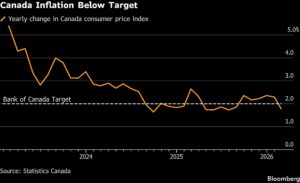
Core measures of inflation also eased by more than expected in February. The consumer price index excluding food and energy was up 2%, while the central bank’s median and trim measures of inflation both fell to 2.3%.
Canada bonds rallied across the curve, with the two-year yield down 6.3 basis points to 2.725% as of 9:14 a.m. in Ottawa.
Shelter prices continued to decelerate last month, and were up just 1.5% from a year ago, the slowest pace in five years amid weak housing resales and smaller rent price increases.
Prices for food — which has been a major sore spot for Canadian consumers — also rose at a slower rate. Yearly inflation on food purchased from stores was 4.1% in February from 4.8% the previous month. The deceleration was led by weaker price growth for frozen or fresh beef.
Still, grocery prices are up a cumulative 30.1% over the past five years.
Meanwhile, a more modest year-over-year deceleration in gasoline prices last month moderated the slowdown in headline inflation, with prices at the pump down 14.2% compared to 16.7% in January.
Gasoline prices were up 3.6% on a monthly basis, largely driven by an increase in oil prices ahead of the Middle East conflict and oil supply disruptions in some producer countries, Statcan said.
Andrew DiCapua, an economist at the Canadian Chamber of Commerce, said higher oil prices from the conflict in Iran are likely to show up in next month’s data too.
“For the Bank of Canada, the signals remain mixed with jobs data and inflation pulling them in different directions. That uncertainty for now will likely keep the Bank on hold at this week’s meeting as it waits for a clearer picture,” DiCapua said in an email.
On Friday, Statistics Canada reported the country lost 83,900 jobs in February, the biggest decline in more than four years.
Policymakers are widely expected to keep the benchmark interest rate unchanged at 2.25% on Wednesday.
–With assistance from Mario Baker Ramirez.
©2026 Bloomberg L.P.
This article was reposted from the Canadian Mortgage Trends website.